Showing posts with label Book Club. Show all posts

Tuesday, 12 July 2011

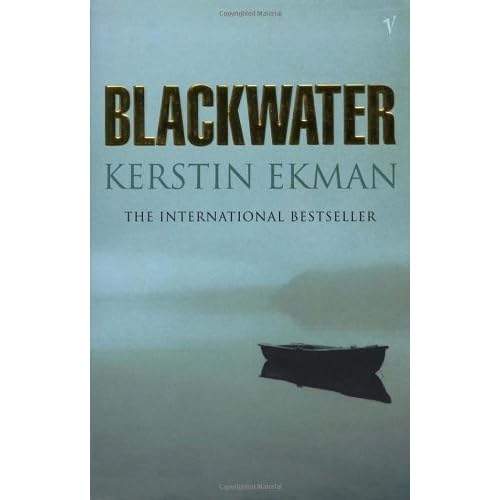
The dark waters of Kerstin Ekman's Blackwater

Hello all!

Only three weeks too late, I thought I'd note down a few of the main points discussed at our last meeting, on 21st June 2011. We'd been reading Blackwater, by Kerstin Ekman. A dark, complex tale of death, and intricate deceit in Northern Sweden (well, central Sweden, technically, but once you get above Uppsala it's all 'northern'...)

The readers' reactions to the book were varied: some loved it, some were skeptical. All were struck by its bleakness, and Ekman's portrayal of nature's power, in an area of the world where the inhabitants are truly in sway to it.

In summary, the book revolves around teacher and mother, Annie Raft, and the eponymous (in the Swedish title) "Events by water". The novel is retrospectively set in the 70s, and focuses on events surrounding, and following a double murder by the Blackwater lake in Jämtland, Northern(-ish) Sweden. The many central characters in the book (a part Sami boy, Johan; the region's only doctor, Birger; the members of a goat-farming mountainside commune; and Annie's daughter, Mia) weave a web of intrigue that is only unravelled very late in the novel, long after the community itself has dissolved.

The victims of the murder are two tourists, visiting Northern Sweden to explore its forested wilderness, captured by the strange beauty of cold lakes and high mountains. They are discovered by Annie Raft, herself new to the region, as she and her young daughter Mia scrabble through the forest in the twilight of Midsummer's Eve, searching for the commune where they are to start anew away from the turmoil of their lives in Southern Sweden.

But the physical darkness of the forest, and the metaphorical darkness of those living in its shadow quickly take their toll. Miscommunication, or perhaps, rather, the total lack of communication, become increasingly central, as the murder case remains unsolved. Johan is whisked away to the residence of a mysterious cult in Norway, Birger's relationship with his wife crumbles, the commune gradually disperse from their perch on Star Mountain's frozen slopes, and Annie realises her beautiful lover is not all he seems.

Ekman tensely describes the claustrophobia of the forest, intertwining the names of flowers and birds unfamiliar to an English reader among the branches of birch trees and the babblings of crystal clear brooks. She renders the imposing progress of the forest clearing machines, changing the landscape, and its inhabitants' lives for ever, with far-reaching consequences for community and ecosystem.

This is a powerful book, one that deals with humans' impact on the environment, on themselves, and on each other. For me, and a number of the readers, the overall effect was one of estrangement. Most people said they found it difficult to relate to a single one of the characters. Indeed, this seems to be Ekman's intention, only adding to the importance of the overpowering presence of nature, surrounding and shutting off each character, until not even the reader can reach them.
________________________________________

Feel free to add any comments below, especially if you think I've missed out something we discussed, or if anything ese has occured to you since we met!

Wednesday, 18 May 2011

Hash, 10 May 2011

Hello everyone,

Emma sent me a wonderfully thoughtful reaction to our last book, Torgny Lindgren's Hash. I will be posting it here, but before I read it all the way through and get overwhelmed, I thought I'd put up a (very) brief summary of last Tuesday's discussion. I welcome corrections and comments!

Where do you begin with a book like Hash? I think we all agreed that it's as ambiguous as the people, places and events described in it. Responses to the book were positive, surprised and enchanted, with a hint of bemused frustration, or maybe just puzzlement among some. One reader suggested that this was, essentially, the point - a confusion of truth and memory and what it might mean to a text.

In bullet points, then, a selection of what we discussed:
  • Characters: Bertil seemed to have aroused the most interest (suspicion?). Who was Robert Maser? Even the characters within the framing story of the aging journalist were ambiguous.
  • Illness - delirium, intoxication, immunity and contagion affecting the characters and narrative in kind.
  • Geographical aspects - how fictional was the landscape described by the journalist? Would have liked to have seen the journalist's hand-drawn map printed in the book.
  • 'Fact files'-style news items inserted into the text, what did these really add? Not taken far enough to really be of significance.
  • 'Writing' as theme: (compare Tove Jansson's Fair Play, April's book).
  • Ambiguity of the (non-)narrative reflecting the experience of living in a remote location. Harshness/susceptibility to nature/disease/poverty - does this influence communication? Could Hash's abstraction relate to that?
  • It was interesting to learn that the geographic isolation of the characters reflected a reality that was not only exotic to a (London-based) UK readership, but also to a Swede from further south in the country!
As you can perhaps tell, the discussion generated as many questions as it answered - as one reader suggested, this is a book that calls for repeated reading.

Thanks, as always, to Fika Swedish Grill and Cafe, for being kind enough to host us, providing a mysigt environment, and delicious brain food in the form of coffee and tunnbrödsrullar.

See you on the 21st June,
Nicky

Saturday, 7 May 2011

Memory gain


Hi!

In preparation for our next book club meeting (next Tuesday, 10th May, 6pm), I thought I'd write a blog post with my initial thoughts on our current book Hash, by Torgny Lindgren. Please leave any comments and points for discussion in the comments field at the bottom of the post!

I hope you all enjoyed the book as much as I did. I hope you were all as surprised and bemused and disoriented by it as I was. And I hope you all have as many contradictory, exhilarating thoughts about it as I have.

What most interested me about this book was its fascination with memory and how personality and imagination can add new dimensions to it. To me it seems that one of the major ideas explored in Hash is the way in which one adds to one's memories to make them one's own. The embellishments with which imagination turns memories from dry events and facts into stories, personalities and visions.

The 'journalist's' imagination creates imagined memories that are inseparable from reality. As he says in his letter to the newspaper editor at the beginning of the book: "You contrast imagination with truth as if the two were incompatible, as if they were mutually exclusive, as if imagination itself were not a product of reality." Our guide's imagination takes us on a journey through personal memories of Västerbotten, in Northern Sweden. His path takes in its cultures, through food, illness and friendship, and its through its landscapes, on an imagined motorcycle.

Through the imagined truth of Lars' and Robert's search for the perfect Swedish Hash, we explore the characters' fascination with food, as well as the community's memory of it (think of Ellen's hash, which everyone swears is the finest in the area, although no one has actually been brave enough to try). Their surety of its greatness is a product of hearsay, and of its heavenly smell. To consume it (as Lars finds out), is to allow oneself to be consumed. Imagining how it might taste is the only lasting truth.

The many layers of memory, real and imagined, create a rich web that is not easy to untangle. Linda's search for Avaberg succeeds only through an imagined map, and though she finally finds the rich seam of gold, it is contingent on the journalist's modest admission that "Imagination is my memory". It is difficult to understand where in the novel Linda's prospecting begins - I might be misremembering it, but it seems to have little pretext in the earlier part of the book. Still, I found this quite exhilarating. The book is almost like a related dream. Stories dissolve into stories, which themselves double back and turn into other stories. Defining a clear sequence of events is far too tough a task for the newly-awakened narrator.

The underlying discussion of life in an old people's home added another aspect to the narrative. For many, he path of aging passes through memory loss to oblivion, a process that institutions try to impede with drugs and therapies. For the journalist, the memory gains he makes through writing his imagined memories are themselves impeded by the authorities that supervise his care.

At every turn, this novel seems to be spinning a web of lessons to learn, and ideas to unravel. My reading of it was confused and perhaps a little superficial, if intrigued and delighted. I wonder how others interpreted it - leave discussion points below as comments, and we can explore them when we meet on Tuesday! Also, for those of you who are unable to make it on Tuesday (I know Tom, Emma -who are in Vietnam- and Agnes -who's recovering from major surgery- are all unable to come), please put down your thoughts, and we can make this a transcontinental conversation!

Wednesday, 16 March 2011

Other things you might like to know about New Swedish Fiction Book Club


Introductory Meeting - meet other readers, have a chat and a drink.

Come and join us!

NOTE CHANGE OF VENUE

**7pm, 24th March**

Fika, Swedish Bar & Grille
161a Brick Lane
London
E1 6SB

(map)

Nicky'll be giving out the first book, Fair Play by Tove Jansson, ready for our first proper book club session on 12th April.
(Image courtesy of Sort Of Books)


~ See you there ~

Thursday, 10 March 2011

All you need to know about New Swedish Fiction Book Club


Välkommen to the New Swedish Fiction Book Club!

A new book club for new Swedish fiction, it's for anyone who's interested in finding out more about Swedish literature; anyone curious about Swedish culture; anyone who likes reading intriguing, beautiful books and talking about them with others who are enthusiastic and critical.

The book club's members will choose the books from shortlists of Swedish (and Finnish-Swedish) fiction in English translations. The focus is on books from the last 10 years, but not that many of these have actually been published, so we can be a bit flexible with this! Some of the texts might be short stories and poems, some novels. The most important thing is that they'll be interesting, imaginative and exciting (we hope).

We eventually see it leading to something bigger, maybe a London, or UK-wide network of book clubs, but we're keeping this one to 10-15 members in order to really get people talking and give everyone a chance to contribute. We intend to develop this blog into a web resource for the group, to continue discussions, post info and generally keep the excitement going. We hope to invite occasional guest speakers, and we might even make some podcasts based on conversations and ideas generated by our discussions.

The project is organised by Nicky Smalley and Agnes Broome, PhD students at UCL's Scandinavian Studies department, and subsidised through AHRC funding from UCL's Public Engagement Unit. This means the books will be cheap, or in some cases free, and there will also be some form of subsidised refreshments available.

It's also part of Nicky's research project - an added bonus. One thing to note is that will make audio recordings of the sessions. Participants will be asked to sign a consent form saying that they are happy to be recorded (the recordings might be used for the podcasts, but more of that later!)